
Space History for April 29
If you are not already a subscriber, you are welcome to enter your email address here to sign up to receive the Space History newsletter on a daily basis. Under no circumstances will we release your legitimate email address entered here to outside persons or organizations, and it will only be used for mailing the specific information you have requested.
| Enter your email address here: |
Unsubscribe instructions are included in every newsletter issue in case you decide you no longer wish to receive it.
Note: We record the IP address from which subscriptions are entered to help prevent SPAM abuses.
Race To Space
Someone will win the prize...
... but at what cost?
Visit RaceToSpaceProject.com
to find out more!
1853
Comet C/1853 G1 (Schweizer) approached within 0.0839 AUs (12.6 million km, 7.8 million miles) of Earth, the seventeenth closest in known history.
ref: cneos.jpl.nasa.gov
1854
Born, Henri Poincare, French mathematician, astronomer, philosopher
ref: en.wikipedia.org
1861
Giovanni Schiaparelli discovered asteroid #69 Hesperia. (Hesperia, or Hespera, was a Greek goddess whose name means 'Light of Evening', believed to be in charge of watering the sacred apple tree.)
ref: en.wikipedia.org
1861
Robert Luther discovered asteroid #68 Leto.
ref: en.wikipedia.org
1893
Born, Harold C. Urey (at Walkerton, Indiana, USA), physicist (deuterium, Nobel 1934 "for his discovery of heavy hydrogen")
ref: www.nobelprize.org
1902
M. Wolf discovered asteroid #484 Pittsburghia.
1921
B. Jekhovsky discovered asteroid #953 Painleva.
1921
Born, Cornelis de Jager, Dutch astronomer, studied the Sun and its relation to climate; his work is used to support global warming theories
ref: en.wikipedia.org
1930
C. Jackson discovered asteroid #1268 Libya.
1938
G. Neujmin discovered asteroid #1484 Postrema.
1953
Born, Nikolai Mikhailovich Budarin (at Kirya, Chuvash ASSR), Russian cosmonaut (Mir 19, Mir 25, ISS 6; nearly 444d 1.5h total time in spaceflight)
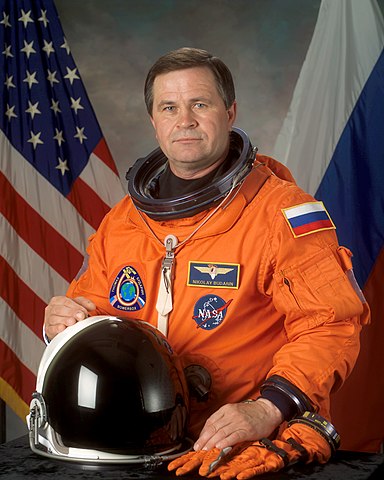
Cosmonaut Nikolai M. Budarin, flight engineer, NASA photo (24 June 2002)
Source: Wikipedia (spaceflight.nasa.gov killed 25 Feb 2021)
ref: www.spacefacts.de

1954
The first launches of three-stage rockets were executed by NACA Langley, from Wallops Island, Virginia.
The first launch of a three-stage rocket vehicle consisting of two Nike boosters in tandem and a Deacon rocket as a third stage was executed on 29 April 1954 by NACA Langley's Pilotless Aircraft Research Division (PARD) at Wallops Island. Also performed on that date was the first launch of a rocket booster system consisting of three "peelaway" Deacons as the first stage wrapped around a fourth Deacon as a second stage, and a HPAG rocket as a third stage.
ref: www.hq.nasa.gov
1985 12:02:18 EDT (GMT -4:00:00)
NASA launched STS 51B (Challenger 7, 17th Shuttle mission) carrying the Spacelab experiment platform for its third flight.
The STS 51-B flight was first manifested as 51E, then rolled back from pad due to a timing problem with the TDRS-B payload. Mission 51-E was cancelled, and the orbiter remanifested with the 51-B payloads. The launch on 29 April 1985 was delayed two minutes, 18 seconds due to a launch processing system failure, but then continued otherwise normally.
The primary payload for STS 51-B was Spacelab-3. It was the first operational flight for the Spacelab orbital laboratory series developed by the European Space Agency. The experiments covered five basic discipline areas: materials sciences, life sciences, fluid mechanics, atmospheric physics, and astronomy. The main mission objective with Spacelab-3 was to provide a high quality microgravity environment for delicate materials processing and fluid experiments. Two monkeys and 24 rodents were observed for effects of weightlessness. Of the fifteen Spacelab primary experiments conducted, fourteen were considered successful. Two Get Away Special (GAS) cannisters were also on board the flight.
STS 51-B ended on 6 May 1985 when Challenger landed on revolution 111 on Runway 17, Edwards Air Force Base, California. Rollout distance: 8,317 feet. Rollout time: 59 seconds. Launch weight: 246,880 pounds. Landing weight: 212,465 pounds. Orbit altitude: 222 nautical miles. Orbit inclination: 57 degrees. Mission duration: seven days, zero hours, eight minutes, 46 seconds. Miles traveled: 2.9 million. The orbiter was returned to Kennedy Space Center on 11 May 1985.
The flight crew for STS 51-B was: Robert F. Overmyer, Commander; Frederick D. Gregory, Pilot; Don L. Lind, Mission Specialist; Norman E. Thagard, Mission Specialist; William E. Thornton, Mission Specialist; Lodewijk van den Berg, Payload Specialist; Taylor G. Wang, Payload Specialist.
ref: www.nasa.gov
1990 06:49:57 PDT (GMT -7:00:00)
NASA's STS 31 (Discovery 10, 35th Shuttle mission) landed at Edwards AFB, California, after carrying the Hubble Space Telescope to orbit.
The STS 31 launch was originally scheduled for 18 April 1990, then moved up to 12 April, then to 10 April, following the Flight Readiness Review (FRR). This was the first time a date set at the FRR was earlier than that shown on previous planning schedules. However, the launch on 10 April was scrubbed at T-4 minutes due to a faulty valve in Auxiliary Power Unit (APU) number one. The APU was replaced, and the payload batteries recharged. The countdown on 24 April 1990 was briefly halted at T-31 seconds when the computer software failed to shut down a fuel valve line on the ground support equipment. Engineers ordered valve to shut manually, and the countdown continued.
STS 31's primary payload, the Hubble Space Telescope, was deployed into a 380 statute mile orbit on 25 April 1990. The secondary payloads were: the IMAX Cargo Bay Camera (ICBC) to document operations outside the crew cabin and a hand-held IMAX camera for use inside the crew cabin; the Ascent Particle Monitor (APM) to detect particulate matter in the payload bay; the Protein Crystal Growth (PCG) experiment to provide data on growing protein crystals in microgravity; Radiation Monitoring Equipment III (RME III) to measure the gamma ray levels in crew cabin; the Investigations into Polymer Membrane Processing (IPMP) experiment to determine porosity control in the microgravity environment; a Shuttle Student Involvement Program (SSIP) experiment to study effects of near-weightlessness on electrical arcs; and the Air Force Maui Optical Site (AMOS) experiment.
STS 31 ended 29 April 1990 when Discovery landed on revolution 80 on Runway 22, Edwards Air Force Base, California, with the first use of the new carbon brakes at landing. Rollout distance: 8,889 feet. Rollout time: 61 seconds. Launch weight: 249,109 pounds. Landing weight: 189,118 pounds. Orbit altitude: 330 nautical miles. Orbit inclination: 28.45 degrees. Mission duration: five days, one hour, 16 minutes, six seconds. Miles traveled: 2.1 million. The orbiter was returned to the Kennedy Space Center on 7 May 1990.
The flight crew for STS 31 was: Loren J. Shriver, Commander; Charles F. Bolden, Jr., Pilot; Steven A. Hawley, Mission Specialist 1; Bruce McCandless II, Mission Specialist 2; Kathryn D. Sullivan, Mission Specialist 3.
ref: www.nasa.gov
1995
An annular solar eclipse visible over the South Pacific and South America occurred. (6 minutes 37 seconds)
ref: en.wikipedia.org
1997
The first joint Russian-US spacewalk occurred when NASA astronaut Jerry Linenger and Mir 23 Commander Vasily Tsibliev attached a monitor to the outside of the Mir space station during a five hour EVA.
ref: www.nasa.gov
2001 00:34:00 CDT (GMT -5:00:00)
NASA's STS 100 (Endeavor) undocked from the International Space Station after delivering the Canadian robotic arm and 6000 pounds of other equipment and supplies.
STS 100 was launched 19 April 2001. Endeavour and its crew remained on orbit almost 12 days, eight of which were spent in joint operations with the International Space Station crew. Endeavour's crew delivered and installed a new robotic arm and helped to transfer equipment and supplies between vehicles.
Mission Specialists Chris Hadfield of the Canadian Space Agency and Scott Parazynski of NASA performed two space walks to install the new 17.6 meter (57.7 foot) robotic arm onto the International Space Station. Canadarm2, a beefier second-generation version of the shuttle's robot arm, is essential to the continued assembly of the space station as the outpost grows beyond the reach of the shuttle's arm.
STS 100 was the first of three space shuttle missions to carry pieces of the Space Station Mobile Servicer System, or SSMSS to the station. It delivered the long, hinged arm known as the Remote Manipulator System. Subsequent missions delivered the Mobile Base System, a work platform that moves along rails covering the length of the space station, and the Special Purpose Dexterous Manipulator, or Canada Hand.
The International Space Station's three Command and Control Computers began to exhibit problems during Endeavour's visit. Communications between the station and the ground were rerouted through Endeavour as flight controllers worked to solve the problem, and mission managers approved an extended stay for the shuttle if the computers were not recovered quickly.
After flight controllers determined that the hard drive on one Command and Control Computer had failed, space station Flight Engineer Susan Helms swapped it with another onboard computer. After reloading the software, all three computers booted up normally. Endeavour brought the failed computer back to Earth for more testing.
STS 100 ended 1 May 2001 when Endeavour landed at Edwards Air Force Base, California, after being waved off from landings at Kennedy Space Center because of the inclement weather in Florida.
The flight crew for STS 100 was: Kent V. Rominger, Commander; Jeffrey S. Ashby, Pilot; Chris A. Hadfield, Mission Specialist 1; John L. Phillips, Mission Specialist 2; Scott E. Parazynski, Mission Specialist 3; Umberto Guidoni, Mission Specialist 4; Yuri V. Lonchakov, Mission Specialist 5.
ref: www.nasa.gov
We are going to run out of oil!
Visit SpacePowerNow.org
to help fix the problem.
SpacePowerNow.org - For Human Survival
Please help support our efforts by shopping from our sponsors.


This newsletter and its contents are
Copyright © 2006-2026 by The L5 Development Group.  All rights reserved.
 - Publication, in part or in whole, requires previous written permission.
 - Academic or personal-use citations must refer to https://L5Development.com
   as their source.
Thank you for your cooperation.