
|
|
Space History for May 3
If you are not already a subscriber, you are welcome to enter your email address here to sign up to receive the Space History newsletter on a daily basis. Under no circumstances will we release your legitimate email address entered here to outside persons or organizations, and it will only be used for mailing the specific information you have requested.
| Enter your email address here: |
Unsubscribe instructions are included in every newsletter issue in case you decide you no longer wish to receive it.
Note: We record the IP address from which subscriptions are entered to help prevent SPAM abuses.
Race To Space
Someone will win the prize...
... but at what cost?
Visit RaceToSpaceProject.com
to find out more!
1661
The third transit of Mercury ever seen and recorded by humans occurred on the day Charles II was crowned King of England, observed by Christiaan Huygens in London.
ref: en.wikipedia.org
1715
Edmund Halley made the first known observation a total solar eclipse phenomenon which later became known as "Baily's Beads."
ref: eclipse.gsfc.nasa.gov
1888
A. Charlois discovered asteroid #277 Elvira.
1923
The first nonstop airplane flight across the US, from New York City to San Diego, California, was completed in a Fokker T-2 flown by two US Army aviators. The total flight time was almost 27 hours.
ref: www.historynet.com
1935
C. Jackson discovered asteroids #1356 Nyanza and #1638 Ruanda.
1949
In the first launch of an American-made high-altitude sounding rocket, Viking 1 flew to an altitude of 51 miles (82 km).
ref: en.wikipedia.org
1951
Goethe Link Observatory discovered asteroid #1952 Hesburgh.
1952
US Lieutenant Colonels Joseph O. Fletcher and William P. Benedict landed a plane at the geographic North Pole, the first ever to do so.
ref: www.history.com
1978
To celebrate "Sun Day," solar energy events were held across the US and around the world.
ref: en.wikipedia.org
1981
E. Bowell discovered asteroids #2411 Zellner, #2685 Masursky, #2844 Hess, #2920 Automedon, #3208 Lunn and #3748.
1982
The New York Times reported that the US military would get 25% of NASA's 1983 budget (and taxpayers wonder why popular programs such as the Hubble Space Telescope are endangered by budget cuts...)
ref: www.nytimes.com
1984
B. A. Skiff discovered asteroid #3325; and L. Zhuravleva discovered asteroid #3616.
1985
The first crystal grown in space from a crystal seed was grown in liquid aboard the STS 51B Shuttle mission.
ref: nssdc.gsfc.nasa.gov
1986 18:19:00 EDT (GMT -4:00:00)
NASA launched the GOES-G weather satellite. The spacecraft was lost when its Delta 3914 booster failed after being struck by lightning shortly after liftoff.
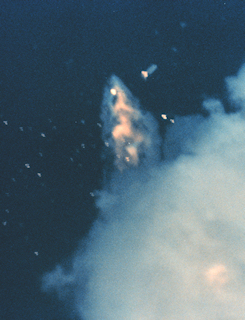
GOES G's explosive end 91 seconds after launch as Range Safety destroys the Delta launch vehicle,
NOAA Photo Library
ref: nssdc.gsfc.nasa.gov
1998 12:08:59 EDT (GMT -4:00:00)
NASA's STS 90 (Columbia 25, 90th Shuttle mission) landed after carrying the Spacelab experiment platform on its final flight.
The 16 April 1998 launch of STS 90 was postponed for 24 hours due to a difficulty with one of Columbia's two network signal processors, which format data and voice communications between the ground and the Space Shuttle. Network signal processor 2 was replaced, and the liftoff on 17 April occurred on time.
STS 90 carried 26 Neurolab experiments which targeted one of the most complex and least understood parts of the human body - the nervous system. The primary goals were to conduct basic research in neurosciences, and to expand our understanding of how the nervous system develops and functions in space. Test subjects were crew members and rats, mice, crickets, snails and two kinds of fish. Neurolab was a cooperative effort of NASA, several domestic partners and the space agencies of Canada (CSA), France (CNES) and Germany (DARA), as well as the European Space Agency (ESA) and the National Space Development Agency of Japan (NASDA). Most of the experiments were conducted in the pressurized Spacelab long module located in Columbia's payload bay. It was sixteenth (and last) scheduled flight of the ESA-developed Spacelab module, although Spacelab pallets will continue to be used on the International Space Station.
The research was conducted as planned, with the exception of the Mammalian Development Team, which had to reprioritize science activities because of the unexpected high mortality rate of neonatal rats on board.
Other payloads included the Shuttle Vibration Forces experiment, the Bioreactor Demonstration System-04, and three Get Away Special (GAS) canister investigations.
Working with engineers on the ground a week into the flight, the on-orbit crew used aluminum tape to bypass a suspect valve in the Regenerative Carbon Dioxide Removal System that had threatened to cut short the mission.
Mission Management Team considered, but decided against, extending the mission one day because the science community indicated an extended flight was not necessary, and weather conditions were expected to deteriorate after the planned landing on Sunday, 3 May 1998.
STS 90 Mission Specialist Kay Hire was Kennedy Space Center's first employee to be chosen as an astronaut candidate.
STS 90 ended 3 May 1998 when Columbia landed on orbit 256 on Runway 33, Kennedy Space Center, Florida, on the first KSC opportunity for the day. Rollout distance: 9,998 feet (3,047 meters). Rollout time: 58 seconds. Orbit altitude: 150 nautical miles. Orbit inclination: 39 degrees. Mission duration: 15 days, 21 hours, 49 minutes, 59 seconds. Miles traveled: 6.375 million statute miles. This flight marked the 14th consecutive Shuttle landing at KSC, and the 21st in the last 22 missions.
The flight crew for STS 90 was: Richard A. Searfoss (3), Commander; Scott D. Altman, Pilot; Richard M. Linnehan DVM, Mission Specialist; Dafydd Rhys Williams MD (CSA), Mission Specialist; Kathryn P. Hire, Mission Specialist; Dr. Jay C. Buckey, Payload Specialist; Dr. James A. Pawelczyk, Payload Specialist.
ref: www.nasa.gov
2001
Died, Karl Sendler, German guided missile expert during World War II, member of the German Rocket Team in the United States after the war, retired 1974 as KSC's director of Instrumentation Systems
ref: www.nasa.gov
2007
Died (heart attack), Walter M. "Wally" Schirra (at San Diego, California, USA), Captain USN, NASA astronaut (Mercury 8, Gemini 6, Apollo 7; nearly 12d 7.25h total time in spaceflight), the only man to fly in all three of America's first space programs
ref: en.wikipedia.org
We are going to run out of oil!
Visit SpacePowerNow.org
to help fix the problem.
SpacePowerNow.org - For Human Survival
Please help support our efforts by shopping from our sponsors.



This newsletter and its contents are
Copyright © 2006-2026 by The L5 Development Group.  All rights reserved.
 - Publication, in part or in whole, requires previous written permission.
 - Academic or personal-use citations must refer to http://L5Development.com as their source.
Thank you for your cooperation.
Space History Department
Resources
The L5 Development Group Home Page
The L5 Development Group Keyword Access System
Space History for May 3 /
Webmaster /
Script last modified August 23, 2018 @ 6:05 am
Copyright © 2006-2026 by The L5 Development Group. All rights reserved.
Hosted by FKEinternet