
|

|
Space History for May 29
If you are not already a subscriber, you are welcome to enter your email address here to sign up to receive the Space History newsletter on a daily basis. Under no circumstances will we release your legitimate email address entered here to outside persons or organizations, and it will only be used for mailing the specific information you have requested.
| Enter your email address here: |
Unsubscribe instructions are included in every newsletter issue in case you decide you no longer wish to receive it.
Note: We record the IP address from which subscriptions are entered to help prevent SPAM abuses.
Race To Space
Someone will win the prize...
... but at what cost?
Visit RaceToSpaceProject.com
to find out more!
1829
Died, Humphry Davy, Cornish chemist and inventor (discovered several alkali and alkaline earth metals, chlorine, iodine, miner's safety lamp)
ref: en.wikipedia.org
1861
C. H. F. Peters discovered asteroid #72 Feronia (named after the Italian goddess of groves).
1885
Born, Erwin Finlay-Freundlich, German astronomer (experiments to test Einstein's general theory of relativity by astronomical observations based on gravitational redshift)
ref: en.wikipedia.org
1889
A. Charlois discovered asteroid #284 Amalia.
1897
Born, Johannes Winkler, German rocket engineer, founded the Society for Space Travel (Verein fur Raumschiffarht - VfR), published The Rocket (Die Rakete), the first journal of rocketry and astronautics
Johannes Winkler (29 May 1897 - 27 December 1947) was a German rocket engineer. While working as an engineer for Junkers Aircraft in Breslau, Winkler became seriously fascinated with Oberth's calculations proving the feasibility of manned space travel using liquid propellant rockets. Winkler founded the pioneering Society for Space Travel (Verein fur Raumschiffarht - VfR) and became its first president. From 1927 to late 1929, he was the editor and publisher of The Rocket (Die Rakete), the first journal of rocketry and astronautics. He quit his job at Junkers and built and flew the first liquid propellant rocket in Germany in 1931. After the failure of his HW-2 rocket he returned to his old job at Junkers, and then worked for the government Luftforschungsanstalt (Aeronautical Research Institute) during World War II. Although he designed a number of JATO units and sounding rockets, none were ever put into production.
ref: www.nmspacemuseum.org
1918
Born, Valentin Yakovlevich Likhushin, Russian engineer, Director of NII-1 1955-1988, specialized in advanced engines
ref: www.astronautix.com
1919
Arthur Eddington made observations of shifted star positions during a solar eclipse, a fact interpreted as confirming gravitational bending of light rays as predicted by Albert Einstein's theory of relativity, and thereby confirming the theory itself.
ref: en.wikipedia.org
1946 21:12:00 GMT
In a V-2 chemical release mission launched from White Sands, New Mexico, rocket # 4 reached 112.4 km, and carried cosmic radiation (Applied Physics Lab, John Hopkins University) experiments for General Electric.
ref: en.wikipedia.org
1962
NASA's Manned Space Flight Management Council approved the mobile launcher concept for the Saturn C-5 at Launch Complex 39, Merritt Island, Florida.
ref: www.hq.nasa.gov
1963
The Titan 2 vertical test facility (VTF) at Martin-Baltimore was activated.
The VTF comprised a 165-foot tower and an adjacent three-story blockhouse with ground equipment similar to that used at complex 19. In it, the completely assembled Gemini launch vehicle was tested to provide a basis for comparison with subsequent tests conducted at complex 19. Each subsystem was tested separately, then combined systems tests were performed, concluding with the Combined Systems Acceptance Test, the final step before the launch vehicle was presented for Air Force acceptance.
ref: history.nasa.gov
1963
The US Air Force launched Titan 2 Research and development flight N-20 to test POGO fixes, but it failed 55 seconds after launch due to a fire in the engine compartment.
Titan II flight N-20, the 19th in the series of Air Force research and development flights, was launched 29 May 1963 from Cape Canaveral. It carried oxidizer standpipes and fuel accumulators to suppress longitudinal oscillations (POGO). During the spring of 1963, static firings of this configuration had been successful enough to confirm the hypothesis that POGO was caused by coupling between the missile structure and its propulsion system, resulting in an unstable closed loop system. Standpipes and accumulators, by interrupting the coupling, reduced the source of instability. Flight N-20 failed 55 seconds after launch due to a fire in the engine compartment caused by a fuel leak and yielded no POGO data. Although the failure was not attributed to the installed POGO fix, Air Force Ballistics Systems Division decided officially that no further Titan II development flights would carry the POGO fix because so few test flights remained to qualify the weapon system operationally. This decision did not stand, however, and the POGO fix was flown again on N-25 (November 1), as well as on two later flights.
ref: en.wikipedia.org
1963 18:43:00 GMT
NASA launched X-15A Aero Heating/VO Stab Test mission # 84 in which Joe Walker reached 3858 mph (6209 kph, Mach 5.52) maximum speed, and a maximum altitude of 92,000 ft (28.042 km, 17.424 mi). During the flight, the left windshield inner panel cracked.
ref: en.wikipedia.org
1965 12:00:00 GMT
NASA launched Explorer 28 (IMP 3) into orbit from Cape Kennedy to study the Earth's magnetic field and collect radiation data.
ref: nssdc.gsfc.nasa.gov
1971
L. Chernykh discovered asteroid #2127 Tanya.
1973 10:19:00 GMT
USSR launched the Meteor 1-15 weather satellite from Plesetsk.
ref: nssdc.gsfc.nasa.gov
1974 07:50:00 GMT
USSR's Cosmos 656 landed after a successful test of the Soyuz 7K-T(A9) variant designed for docking with the military Almaz space station, used in the Apollo-Soyuz Test Program (ASTP).
ref: nssdc.gsfc.nasa.gov
1974 08:57:00 GMT
USSR launched the Luna 22 orbiter to the Moon.
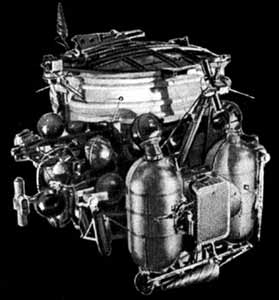
USSR's Luna 22 probe
Source: NSSDCA Master Catalog
Luna 22 was a heavy Lunar orbiter launched 29 May 1974, first into Earth parking orbit and then to the Moon, where it was inserted into a circular Lunar orbit on 2 June 1974. It was launched for scientific investigation of the Moon and circumlunar space from the orbit of an artificial satellite of the Moon, which was begun by the Luna 19 automatic station. The primary instruments were the imaging cameras the spacecraft carried. It also had the objectives of studying the Moon's magnetic and gravitational fields, surface gamma ray emissions and (thereby) the composition of Lunar surface rocks, as well as micrometeorites and cosmic rays. The spacecraft made many orbit adjustments over its 18 month lifetime in order to optimize the operation of various experiments, lowering the perilune to as little as 25 km. Maneuvering fuel was exhausted on 2 September 1975, and the mission was ended in early November 1975.
ref: nssdc.gsfc.nasa.gov
1980 10:53:00 GMT
The NOAA B weather satellite was launched from Vandenburg, but ended up in an unusable orbit after amazingly surviving an extensive set of failures. If successful, it would have been NOAA 7.
NOAA B was the second in a series of third-generation, operational meteorological satellites for use in the National Operational Environmental Satellite Subsystem (NOESS) and to support the Global Atmospheric Research Program (GARP) during 1978-84. The satellite design provided an economical and stable Sun-synchronous platform for advanced operational instruments to measure the Earth's atmosphere, its surface and cloud cover, and the near-space environment. Primary sensors included an advanced very high resolution radiometer (AVHRR) for observing day and night global cloud cover, and an operational vertical sounder for obtaining temperature and water vapor profiles through the Earth's atmosphere. Secondary experiments consisted of a space environment monitor (SEM), which measured the proton and electron flux near the Earth, and a data collection and platform location system (DCS), which processed and relayed to central data acquisition stations the various meteorological data received from free-floating balloons and ocean bouys distributed around the globe. The satellite was based upon the Block 5D spacecraft bus developed for the US Air Force, and was capable of maintaining an Earth pointing accuracy of better than plus or minus 0.1 degree with a motion rate of less than 0.035 degree/second.
NOAA B was launched 29 May 1980. At engine start up, one of the Atlas booster engines suffered an internal fuel leak, causing it to run at about 80% thrust. As a result, the booster was low on velocity and heavy on propellant over much of its flight, and ran an incredible 50 seconds longer than the nominal burn. The NOAA Advanced TIROS payload was designed with no direct communication with the booster, and, unaware of the booster problem, at 375 seconds after liftoff, attempted to separate with the booster still firing. The booster's continued thrusting defeated the payload's attempt to perform the required pitch maneuver. When the payload fired its apogee kick motor, it blew the top of the booster's liquid oxygen tank off. The spacecraft survived all this, but the resultant orbit was highly elliptical rather than the desired circular sun-synchronous. The mission was therefore a total loss.
ref: nssdc.gsfc.nasa.gov
1982 22:04:00 GMT
USSR launched Molniya 1-54 from Plesetsk, replacing Molniya 1-44, for operation of the long-range telephone and telegraph system in the USSR, and transmission of USSR Central Television programs to stations in the Orbita network.
ref: nssdc.gsfc.nasa.gov
1985 07:41:00 GMT
USSR launched Molniya 3-24, replacing Molniya 3-18, for operation of the USSR long-range telephone and telegraph system, transmission of USSR Central Television programs in the Orbita network, and within the framework of international cooperation.
ref: nssdc.gsfc.nasa.gov
1986
The unmanned USSR Soyuz TM 1 undocked from the Mir space station in the maiden flight of the spacecraft that became the successor of the Soyuz capsules used in the Salyut 7 program.
ref: en.wikipedia.org
1990 07:19:00 GMT
USSR launched the Resurs F-06 Earth resource satellite, which also carried a German microgravity experiment in accordance with a commercial agreement, for the purpose of conducting biotechnological experiments.
ref: nssdc.gsfc.nasa.gov
1991 22:55:00 GMT
The Alascom Aurora 2 communications satellite was launched from Cape Canaveral, positioned in geosynchronous orbit at 139 deg W in 1991-1999.
Aurora 2, an Alaskan owned telecommunications satellite, was launched 29 May 1991 from Cape Canaveral aboard a Delta booster rocket. It provided telephone, television, maritime, radio and emergency communications service for the northern state's long distance carrier, Alascom, as well as radio and data services for GE Americom. The satellite carried 32 C-band transponders (24 primary and 6 redundant) operating at 6/4 GHz. [Ed. note: NASA's math doesn't add up here: 24+6 != 32] Sixteen of the 24 channels served Alaskan customers, 8 served US business. Built by GE Astro-Space for Alascom, Aurora 2 was box-shaped, measuring 1 by 1.64 by 1.4 m. Two three-panel solar arrays, totalling 13 sq. m, extended from either side of the main body. The fixed dual-polarization reflector antenna covered the continental US, Alaska and Hawaii. It replaced Aurora 1, which was retired after 9 years of service. Stationed above 139 degrees W, Aurora 2 became operational in July 1991, with a 12 year life expectancy. As of 30 August 2001, it was at 148.31 deg E drifting at 4.531 deg W per day.
ref: nssdc.gsfc.nasa.gov
1996 07:09:18 EDT (GMT -4:00:00)
NASA's STS 77 (Endeavour 11, 77th Shuttle mission) ended after carrying SPACEHAB and Spartan/IAE into orbit.
The original STS 77 launch date of 16 May 1996 was changed to 19 May due to conflicts with the Eastern Range schedule. The 19 May 1996 countdown proceeded smoothly to an on-time liftoff.
The fourth Shuttle flight of 1996 was highlighted by four rendezvous activities with two different payloads. The primary payloads, all located in the cargo bay, were the SPACEHAB-4 pressurized research module; the Inflatable Antenna Experiment (IAE) mounted on Spartan 207 free-flyer; and a suite of four technology demonstration experiments known as Technology Experiments for Advancing Missions in Space (TEAMS). More than 90 percent of the payloads were sponsored by NASA's Office of Space Access and Technology.
SPACEHAB-4 was a single module which carried nearly 3,000 pounds (1,361 kilograms) of support equipment, and a variety of experiments covering such fields as biotechnology, electronic materials, polymers and agriculture, including: Advanced Separation Process for Organic Materials (ADSEP); Commercial Generic Bioprocessing Apparatus (CGBA); Plant Generic Bioprocessing Apparatus (PGBA); Fluids Generic Bioprocessing Apparatus-2 (FGBA-2); Commercial Protein Crystal Growth (CPCG); Gas Permeable Polymer Membrane (GPPM); Handheld Diffusion Test Cell (HHDTC); Commercial Float Zone Furnace (CFZF); and the Space Experiment Facility (SEF). Also considered part of the SPACEHAB payload complement, but located in middeck lockers, were the IMMUNE-3 and NIH-C7 payloads. CFZF, sponsored by NASA and the German and Canadian space agencies, was considered the top priority SPACEHAB-4 payload; designed to produce large, ultra-pure crystals of such semiconductor materials as gallium arsenide. FGBA-2, an on-orbit soft-drink dispenser, required some troubleshooting, and the SEF experiment was declared failed when command problems with the payload could not be fixed.
The Spartan free-flyer was deployed on flight day two using the orbiter Remote Manipulator System (RMS) arm. The 132-pound (60-kilogram) IAE antenna structure, mounted on three struts, was inflated to its full size of 50 feet (15 meters) in diameter, about the size of a tennis court. The potential benefits of inflatable antennas over conventional rigid structures include their lower development costs, greater reliability, and lower mass and volume, requiring less stowage space and potentially a smaller launch vehicle. The actual on-orbit performance of the antenna - its surface smoothness - was documented with cameras and sensors for later analysis. The deployment and inflation proceeded smoothly, and the IAE was jettisoned 90 minutes later into an orbit from which it re-entered the Earth's atmosphere on 22 May. On flight day three, the Spartan 207 pallet was returned to the orbiter cargo bay.
Satellite deployment and rendezvous activities were also conducted with Passive Aerodynamically-Stabilized Magnetically-Damped Satellite (PAMS), one of four Technology Experiments for Advancing Missions in Space (TEAMS) research payloads. TEAMS payloads were located in the Hitchhiker carrier in the payload bay. The Satellite Test Unit (STU) on PAMS was deployed on flight day four. Three orbiter rendezvous were conducted with the satellite from a distance of 2,000-2,300 feet (610-701 meters) away to acquire satellite attitude information. STU relied on aerodynamic stabilization rather than attitude control propellants to properly orient itself. After some difficulty, the Attitude Measurement System (AMS) in the payload bay successfully locked onto the satellite and began accurately tracking it, with initial indications showing that the concept of propellant-free aerodynamic stabilization works.
Other TEAMS experiments were the Global Positioning System (GPS) Attitude and Navigation Experiment (GANE); Vented Tank Resupply Experiment (VTRE); and Liquid Metal Thermal Experiment (LMTE).
Secondary experiments included: Brilliant Eyes Ten Kelvin Sorption Cryocooler Experiment (BETSCE), an instrument designed to supercool infrared and other sensors through cyclical release and absorption of hydrogen; Aquatic Research Facility (ARF), a joint Canadian Space Agency/NASA project that allows investigation of wide range of small aquatic species, including starfish, mussels and sea urchins; Biological Research in a Canister (BRIC 07) to study endocrine functioning; Tank Pressure Control Experiment/Reduced Fill Level (TPCE/RFL) to develop pressure control for cryogenic tankage; and a series of experiments flying in Get Away Special (GAS) canisters.
Casper spoke with Mir cosmonaut and US astronaut Shannon Lucid, who was entering her 65th day aboard the Mir space station.
No significant on-orbit problems with the orbiter were reported.
STS 77 ended 29 May 1996 when Endeavour landed on revolution 161 on Runway 33, Kennedy Space Center, Florida, on the first opportunity at KSC. Orbit altitude: 153 nautical miles. Orbit inclination: 39 degrees. Rollout distance: 9,291 feet (2,832 meters). Rollout time: 42 seconds. Mission duration: 10 days, zero hours, 39 minutes, 18 seconds. Miles traveled: 4.1 million.
The flight crew for STS 77 was: John H. Casper, Commander; Curtis L. Brown Jr., Pilot; Daniel W. Bursch, Mission specialist; Mario Runco, Jr., Mission Specialist; Marc Garneau, Mission Specialist (CSA); Andrew S. W. Thomas, Mission Specialist.
ref: www.nasa.gov
1998
The US Air Force Space Command transferred control of the Defense Meteorological Satellite Program (DMSP) to the National Oceanographic and Atmospheric Administration (NOAA).
ref: web.archive.org
2000 01:20:00 CDT (GMT -5:00:00)
NASA's STS 101 (Atlantis) landed after completing the International Space Station Flight 2A.2a mission.
STS 101 was launched 19 May 2000, an ISS logistics flight. During the mission, the shuttle Atlantis spent nearly 10 days in space, six of which (20 May - 26 May) were spent docked with the International Space Station.
On STS 101, Atlantis flew as the most updated space shuttle ever, outfitted with a new "glass cockpit" which was 34 kilograms (75 pounds) lighter and used less power than before, and other state-of-the-art upgrades to key systems, including more than 100 new modifications incorporated during a ten month period at Boeing's Palmdale, California, shuttle factory in 1998. Among the improvements: Atlantis' airlock was relocated to the payload bay to prepare for International Space Station assembly flights; the communications system was updated; several weight reduction measures were installed; enhancements were made to provide additional protection to the cooling system; and the crew cabin floor was strengthened.
While docked with the space station, the crew refurbished and replaced components in both the Zarya and Unity Modules. Voss and Williams performed a 6.5 hour space walk the day after docking to install a Russian Strela cargo boom on the outside of Zarya. They also replaced a faulty radio antenna and performed several other tasks in advance of space walks on future station assembly missions.
The top priority for STS 101 was to replace four of six 800 ampere batteries in the Zarya Module. Zarya received additional new equipment: four cooling fans and ducting to improve airflow, three fire extinguishers, ten smoke detectors, and an onboard computer. A suspect radio frequency power distribution box in Unity used as part of the early S-band communications system was also replaced.
Three hour-long orbit raising burns on 24 and 25 May by the Reaction Control System (RCS) engines on Atlantis were used to raise the station to a 372 x 380 km x 51.6 deg orbit.
STS 101 ended on 29 May 2000 when Atlantis landed at the Kennedy Space Center, Florida. It was the fourteenth nighttime landing in Shuttle history, and the twenty-second consecutive mission to end with a landing at KSC. Mission duration: 9 days, 20 hours, 9 minutes. Orbit altitude: 173 nautical miles. Orbit inclination: 51.6 degrees. Miles traveled: 4.1 million.
The flight crew for STS 101 was: James D. Halsell, Commander; Scott J. Horowitz, Pilot; Mary Ellen Weber, Mission Specialist 1; Jeffrey N. Williams, Mission Specialist 2; James S. Voss, Mission Specialist 3; Susan J. Helms, Mission Specialist 4; Yuri V. Usachev (RSA), Mission Specialist 5. For Usachev, Voss and Helms, the short visit to the ISS was a preview of the much longer time they would spend aboard the outpost as the Expedition Two crew in 2001.
ref: en.wikipedia.org
2014
Died, Dr. Peter E. Glaser, Czech-born American scientist and aerospace engineer, patented the solar power satellite concept which is the economic basis of the L5 Development Group's space development program
Dr. Peter Edward Glaser (5 September 1923 – 29 May 2014) was a Czechoslovakian-born American scientist and aerospace engineer, who patented the solar power satellite concept, among his many other achievements. He was employed at Arthur D. Little, Inc., Cambridge, MA (1955-'94), serving as Vice President, Advanced Technology (1985-'94), and subsequently as a consultant to the company (1994–2005). He was president of Power from Space Consultants (1994–2005), and retired in 2005.
Dr. Glaser's work covered many important areas in both Earth-bound and space development. His professional papers and some of his personal papers (32 cubic feet in 96 boxes) are on deposit at the Massachusetts Institute of Technology Library Archives.
ref: en.wikipedia.org
2014
The ISEE3 Reboot Project team contacted NASA's ISEE3/ICE probe and commanded it into Engineering Mode to begin sending telemetry.
The Explorer-class heliocentric spacecraft, International Sun-Earth Explorer 3, was part of the mother/daughter/heliocentric mission (ISEE 1, 2, and 3). The purposes of the mission were: (1) to investigate solar-terrestrial relationships at the outermost boundaries of the Earth's magnetosphere; (2) to examine in detail the structure of the solar wind near the Earth and the shock wave that forms the interface between the solar wind and Earth's magnetosphere; (3) to investigate motions of and mechanisms operating in the plasma sheets; and, (4) to continue the investigation of cosmic rays and solar flare emissions in the interplanetary region near 1 AU.
The three spacecraft carried a number of complementary instruments for making measurements of plasmas, energetic particles, waves, and fields. The mission thus extended the investigations of previous IMP spacecraft. The launch of three coordinated spacecraft in this mission permitted the separation of spatial and temporal effects. ISEE 3, launched 12 August 1978, had a spin axis normal to the ecliptic plane and a spin rate of about 20 rpm. It was initially placed into an elliptical halo orbit about the Lagrangian libration point (L1) 235 Earth radii on the sunward side of the Earth, where it continuously monitored changes in the near-Earth interplanetary medium. In conjunction with the mother and daughter spacecraft, which had eccentric geocentric orbits, this mission explored the coupling and energy transfer processes between the incident solar wind and the Earth's magnetosphere. In addition, the heliocentric ISEE 3 spacecraft also provided a near-Earth baseline for making cosmic-ray and other planetary measurements for comparison with corresponding measurements from deep-space probes. ISEE 3 was the first spacecraft to use the halo orbit.
In 1982, ISEE 3 began the magnetotail and comet encounter phases of its mission. A maneuver was conducted on 10 June 1982 to remove the spacecraft from the halo orbit around the L1 point and place it in a transfer orbit involving a series of passages between Earth and the L2 (magnetotail) Lagrangian libration point. After several passes through the Earth's magnetotail, with gravity assists from Lunar flybys in March, April, September and October of 1983, a final close Lunar flyby (119.4 km above the Moon's surface) on 22 December 1983 ejected the spacecraft out of the Earth-Moon system and into a heliocentric orbit ahead of the Earth, on a trajectory intercepting that of Comet Giacobini-Zinner. At this time, the spacecraft was renamed International Cometary Explorer (ICE). A total of fifteen propulsive maneuvers (four of which were planned in advance) and five Lunar flybys were needed to carry out the transfer from the halo orbit to an escape trajectory from the Earth-Moon system into a heliocentric orbit.
The primary scientific objective of ICE was to study the interaction between the solar wind and a cometary atmosphere. As planned, the spacecraft traversed the plasma tail of Comet Giacobini-Zinner on 11 September 1985, and made in situ measurements of particles, fields, and waves. It also transited between the Sun and Comet Halley in late March 1986, when other spacecraft (Giotto, Planet-A, MS-T5, VEGA) were also in the vicinity of Comet Halley on their early March comet rendezvous missions. ICE became the first spacecraft to directly investigate two comets. ICE data from both cometary encounters are included in the International Halley Watch archive.
Tracking and telemetry support were provided by the DSN (Deep Space Network) starting in January 1984. The ISEE-3/ICE bit rate was nominally 2048 bps during the early part of the mission, and 1024 bps during the Giacobini-Zinner comet encounter. The bit rate then successively dropped to 512 bps (on 9/12/85), 256 bps (on 5/1/87), 128 bps (on 1/24/89) and finally to 64 bps (on 12/27/91).
As of January 1990, ICE was in a 355 day heliocentric orbit with an aphelion of 1.03 AU, a perihelion of 0.93 AU and an inclination of 0.1 degree.
An update to the ICE mission was approved by NASA headquarters in 1991. It defined a Heliospheric mission for ICE consisting of investigations of coronal mass ejections in coordination with ground-based observations, continued cosmic ray studies, and special period observations such as when ICE and Ulysses were on the same solar radial line. By May 1995, ICE was being operated with only a low duty cycle, with some support being provided by the Ulysses project for data analysis. Termination of operations of ICE/ISEE3 was authorized 5 May 1997.
In 1999, NASA made brief contact with ICE to verify its carrier signal.
On 18 September 2008, NASA located ICE with the help of KinetX using the Deep Space Network after discovering it had not been powered off after the 1999 contact. A status check revealed that all but one of its 13 experiments were still functioning, and it still had enough propellant for 150 m/s (490 ft/s) of Δv (velocity change).
In early 2014, space enthusiasts started discussing reviving ICE when it approached the Earth in August. However, officials with the Goddard Space Flight Center said the Deep Space Network equipment required for transmitting signals to the spacecraft had been decommissioned in 1999, and was too expensive to replace.
On 15 May 2014, the ISEE-3 Reboot Project successfully raised $125,000 through crowdfunding to re-establish communications with the probe.
On 29 May 2014, the reboot team commanded the probe to switch into Engineering Mode to begin to broadcast telemetry. Project members, using the Goldstone Deep Space Communications Complex DSS-24 antenna, achieved synchronous communication on 26 June and obtained the four ranging points needed to refine the spacecraft's orbital parameters, data needed to calculate maneuvers required to bring the satellite out of heliocentric orbit. The reboot project successfully fired the thrusters on 2 July for the first time since 1987. They spun up the spacecraft to its nominal roll rate, in preparation for the upcoming trajectory correction maneuver in mid-July. However, a longer sequence of thrusters firings on 8 July failed, apparently due to a loss of the nitrogen gas used to pressurize the fuel tanks. The ISEE-3 Reboot Team announced that all attempts to change orbit using the ISEE-3 propulsion system had failed on 24 July. They began shutting down propulsion components to maximize the electrical power available for the science experiments.
In late July 2014, ISEE-3 Reboot Project announced the ISEE-3 Interplanetary Citizen Science Mission would gather data as the spacecraft flies by the Moon on August 10 and continues in heliocentric orbit. With five of the 13 instruments on the spacecraft still working, the science possibilities include listening for gamma ray bursts, where observations from additional locations in the solar system can be valuable. The team plans to acquire data from as much of ISEE-3's 300-day orbit as possible and the project is recruiting additional receiving sites around the globe to improve diurnal coverage. They may upload additional commands while the spacecraft is close to Earth, after which they will mostly be receiving data.
On 10 August 2014, ICE passed the Moon at a distance of approximately 15,600 km (9600 mi) from the surface and continued into heliocentric orbit. It will return to Earth's vicinity in about 17 years.
ref: nssdc.gsfc.nasa.gov
We are going to run out of oil!
Visit SpacePowerNow.org
to help fix the problem.
SpacePowerNow.org - For Human Survival
Please help support our efforts by shopping from our sponsors.

This newsletter and its contents are
Copyright © 2006-2026 by The L5 Development Group.  All rights reserved.
 - Publication, in part or in whole, requires previous written permission.
 - Academic or personal-use citations must refer to http://L5Development.com as their source.
Thank you for your cooperation.
Space History Department
Resources
The L5 Development Group Home Page
The L5 Development Group Keyword Access System
Space History for May 29 /
Webmaster /
Script last modified August 23, 2018 @ 6:05 am
Copyright © 2006-2026 by The L5 Development Group. All rights reserved.
Hosted by FKEinternet