

Space History for June 1
If you are not already a subscriber, you are welcome to enter your email address here to sign up to receive the Space History newsletter on a daily basis. Under no circumstances will we release your legitimate email address entered here to outside persons or organizations, and it will only be used for mailing the specific information you have requested.
| Enter your email address here: |
Unsubscribe instructions are included in every newsletter issue in case you decide you no longer wish to receive it.
Note: We record the IP address from which subscriptions are entered to help prevent SPAM abuses.
Race To Space
Someone will win the prize...
... but at what cost?
Visit RaceToSpaceProject.com
to find out more!
1633
Born, Geminiano Montanari, Italian astronomer (recorded Algol as a variable star)
ref: en.wikipedia.org
1831
James Clark Ross discovered the position of the North Magnetic Pole on the Boothia Peninsula.
ref: en.wikipedia.org
1846
Urbain Le Verrier presented to the French Academy calculations indicating the position, but not the mass or orbit, of a planet beyond Uranus. He placed Neptune within one degree of where it was found.
ref: en.wikipedia.org
1894
Born, Anatoli Arkadyevich Blagonravov, Russian scientist, President of the Academy of Artillery Sciences 1946-1950, lead Soviet upper atmosphere exploration using sounding rockets, USSR member of the UN Committee on the Peaceful Uses of Outer Space
ref: en.wikipedia.org
1907
Born, Sir Frank Whittle, Royal Air Force officer, inventor (turbine jet engine)
ref: en.wikipedia.org
1928
Born, Georgi Timofeyevich Dobrovolski (at Odessa, Odessa Oblast, Ukrainian SSR), Lt Colonel Soviet AF, Soviet cosmonaut (Soyuz 11/Salyut 1; over 23d 18.25h in spaceflight) (deceased)

Cosmonaut Georgi Dobrovolski
Source: Wikipedia
Georgi Timofeyevich Dobrovolski (1 June 1928 - 29 June 1971) was a Soviet cosmonaut who flew on the Soyuz 11 mission, and had the unfortunate distinction of being part of the first acknowledged Soviet crew to die during a space flight: After a normal re-entry, the capsule was opened, and the crew was found dead. It was discovered that a valve had opened just prior to leaving orbit that had allowed the capsule's atmosphere to vent away into space, suffocating the crew.
ref: www.spacefacts.de
1950
Born, Gennadi Mikhailovich Manakov (at Yefimovka, Orenburg Oblast, Russian SFSR), Colonel Soviet AF, Soviet cosmonaut (Mir 7, Mir 13; over 309d 21.25h total time in spaceflight) (deceased)
ref: www.spacefacts.de
1951
S. Arend discovered asteroids #1592 Mathieu and #1593 Fagnes.
1955
As a rocket test stand improvement, the first experimental use was made at NACA Lewis Labs of a "boot-strap" rocket-exhaust powered ejector, to permit testing at simulated high-altitude conditions without complicated and expensive exhausting facilities.
ref: www.hq.nasa.gov
1962 09:38:00 GMT
USSR launched Zenit-2 11F61 S/N 3 which suffered a Block B strap-on engine stage shutdown 1.8 seconds after liftoff. The booster crashed 300 m from the pad, and did enough damage to put the launch complex out of operation for a month.
ref: en.wikipedia.org
1962 18:51:00 GMT
NASA launched X-15A ASAS, 23 alpha, M-5 test mission # 55 in which USAF Maj Robert White reached 3675 mph (5914 kph, Mach 5.42) max speed, 132,600 ft (40.416 km, 25.114 mi) altitude, steepest reentry descent, highest angle of attack (27 degrees) to date.
ref: en.wikipedia.org
1963 02:50:00 GMT
USSR launched the DS-MT #1 astronomy satellite from Kapustin Yar, but the booster suffered a first stage failure four seconds after launch.
ref: space.skyrocket.de
1966 15:00:02 GMT
NASA launched the Gemini 9 Augmented Target Docking Adapter (ATDA).
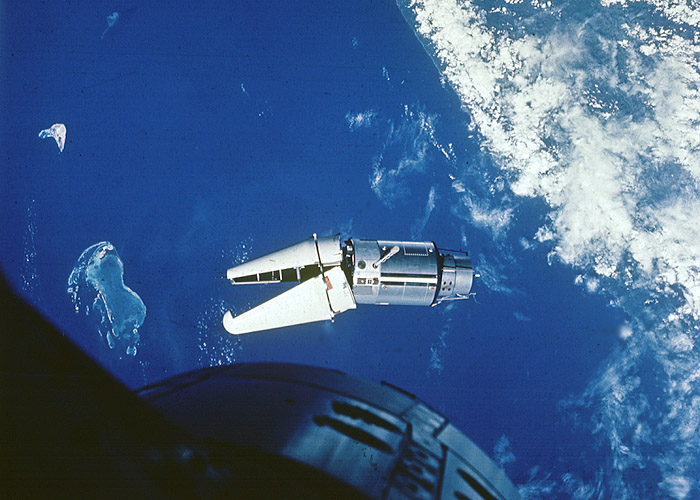
Gemini 9 ATDA in orbit, photographed from Gemini 9, NASA photo
Source: NSSDCA Master Catalog
The Gemini 9 Augmented Target Docking Adapter (ATDA) was launched from Cape Canaveral using an Atlas-Agena D rocket on 1 June 1966. The spacecraft was successfully injected into a near-circular 304 km orbit (apogee 161.5, perigee 158.5 nautical miles), but telemetry signals indicated that the launch shroud, which covered the docking adaptor, had separated but had not been jettisoned. One hour and 40 minutes later, the scheduled launch of Gemini 9A was postponed by a ground equipment failure which prevented the transfer of updating information from the Cape Kennedy mission control center to the spacecraft computer. The mission was recycled for launch on 3 June, following a prepared 48 hour recycle plan. When Gemini 9A was launched two days later, the ATDA failure was confirmed when the astronauts observed the launch shroud still on the ATDA blocking the docking port, looking, according to Tom Stafford, like an "angry alligator." Rendezvous within 8 meters of the ATDA was achieved by Gemini 9 on the third revolution. The shroud had not jettisoned because the lanyards had been installed improperly with the loose ends taped down, due to "insufficiently detailed" instructions. Plans to cut the fiberglass shroud loose were considered but discarded as too dangerous to the astronauts. The flight plan was then revised, and Gemini 9 completed two different equiperiod rendezvous maneuvers with the ATDA. The ATDA was left in a 290 x 300 km orbit.
The Augmented Target Docking Adapter had been prepared as a backup target in case of an Agena Target Vehicle failure. The ATDA was a short cylinder consisting of a target docking adapter cone mounted on front and containing a communications system, a guidance and control system, and a reaction control system. It also had running lights, but unlike the Gemini Agena Target Vehicles, the ATDA was not stabilized.
ref: nssdc.gsfc.nasa.gov
1967
NASA completed the download of pictures from the Lunar Obiter 4 probe in orbit around the Moon.
Lunar Orbiter 4, launched 4 May 1967, was designed to take advantage of the fact the three previous Lunar Orbiters had completed the required needs for Apollo mapping and site selection. It was given a more general objective, to "perform a broad systematic photographic survey of Lunar surface features in order to increase the scientific knowledge of their nature, origin, and processes, and to serve as a basis for selecting sites for more detailed scientific study by subsequent orbital and landing missions." It was also equipped to collect selenodetic, radiation intensity, and micrometeoroid impact data. The spacecraft was placed in a cislunar trajectory and injected into an elliptical near polar high Lunar orbit on 7 May 1967 for data acquisition. The orbit was 2706 km x 6111 km with an inclination of 85.5 degrees and a period of 12 hours.
After initial photography on 11 May 1967, problems started occurring with the camera's thermal door, which was not responding well to commands to open and close. Fear that the door could become stuck in the closed position, covering the camera lenses, led to a decision to leave the door open. This required extra attitude control manuevers on each orbit to prevent light leakage into the camera which would ruin the film. On 13 May it was discovered that light leakage was damaging some of the film, and the door was tested and partially closed. Some fogging of the lens was then suspected due to condensation resulting from the lower temperatures. Changes in the spacecraft's attitude raised the temperature of the camera and generally eliminated the fogging. Continuing problems with the readout drive mechanism starting and stopping beginning on 20 May resulted in a decision to terminate the photographic portion of the mission on 26 May. Despite problems with the readout drive, the entire film was read and transmitted. The spacecraft acquired photographic data from 11 May to 26 May 1967, and readout occurred through 1 June 1967. The orbit was then lowered to gather orbital data for the upcoming Lunar Orbiter 5 mission.
A total of 419 high resolution and 127 medium resolution frames were acquired covering 99% of the Moon's near side at resolutions from 58 meters to 134 meters. Accurate data were acquired from all other experiments throughout the mission. Radiation data showed increased dosages due to solar particle events producing low energy protons. The spacecraft was used for tracking purposes until it impacted the Lunar surface due to the natural decay of the orbit on 31 October 1967, between 22 and 30 degrees W longitude.
Results of the Lunar Orbiter Program
NASA's Lunar Orbiter program consisted of 5 Lunar Orbiters which returned photographs of 99% of the surface of the Moon (both the near and far sides) with resolution down to 1 meter. Altogether the Orbiters returned 2180 high resolution and 882 medium resolution frames. The micrometeoroid experiments recorded 22 impacts showing the average micrometeoroid flux near the Moon was about two orders of magnitude greater than in interplanetary space but slightly less than the near Earth environment. The radiation experiments confirmed that the design of the Apollo hardware would protect the astronauts from average and greater-than-average short term exposure to solar particle events. The use of the Lunar Orbiters for tracking to evaluate the Manned Space Flight Network tracking stations and Apollo Orbit Determination Program was successful, with three Lunar Orbiters (2, 3, and 5) being tracked simultaneously from August to October 1967. The Lunar Orbiters were all eventually commanded to crash on the Moon before their attitude control gas ran out so they would not present navigational or communications hazards to the later Apollo flights.
See also Wikipedia, Lunar Orbiter 4
ref: nssdc.gsfc.nasa.gov
1970
NASA completed the Shuttle Phase A evaluations.
After over 200 man-years of NASA and contractor effort, the Agency reached the following conclusions at the end of Phase A:
* The common orbiter/booster engine planned would have to have a lower thrust than originally proposed, with more used per booster, due to the need for the orbiter to have several engines instead of one or two in order to give it abort capabilities in the event of a single engine failure. It was recommended that a 180,000 kgf engine be developed for the shuttle instead of the 230,000 kgf previously planned.
* Lifting body configurations were not suited for the launch vehicle application, due to the required complex internal arrangement of tanks and equipment within the curving hull, difficulty of fabricating the airframe and tanks, and poor subsonic lift/drag performance.
* Variable geometry wings were not desirable, since they resulted in a heavier weight to body area ratio during re-entry, and thereby, more re-entry heating problems. They also required complex mechanical and pneumatic/hydraulic systems for operation, which meant more maintenance, more complexity, and extra failure modes. Their considerable advantages - a lower spacecraft weight fraction and the highest lift/drag in subsonic flight - did not offset these disadvantages.
As a result of these conclusions, NASA published its specification for the Phase B Integral Launch and Recovery Vehicle Shuttle System on 1 June 1970. The requirements in this specification were:
* Two-stage-to-orbit, vertical takeoff, horizontal landing configuration
* Initial operational capability by the end of 1977
* 6,800 kg payload to a 500 km, 55 deg inclination orbit when launched from Cape Canaveral
* 4.6 m x 18.3 m payload bay
* Two orbiter alternates were to be proposed by the contractors, one with a 370 km cross-range (NASA requirement), one with a 2784 km cross range (USAF requirement). This implied a minimum L/D for the high cross-range vehicle of 1.8, and a total heat load 5 to 7 times greater than the low cross-range alternative.
* Seven-day orbital mission capability.
* Go-around capability on landing in case of a missed approach, which implied use of airbreathing engines. Phase A studies showed that use of gaseous hydrogen from the orbiter's tanks as fuel for such engines drastically reduced the orbiter weight compared to use of conventional JP-4 jet fuel housed in separate tanks.
* Design to be capable of 25 to 70 launches a year, with a turnaround time of two weeks
* G-forces limited to 3G on ascent
* Two crew housed in a pressure cabin without spacesuits
* 43 hour countdown time after assembly
* Stage separation without the use of rocket devices
* No in-flight refuelling allowed
* Capable of landing under FAA Category 2 conditions on a 3,000 m runway
* All systems fail-operational - e.g. they would remain operational after any single component failure, and remain fail-safe for crew survival even after two subsystem failures
* Quick safeing of vehicle systems after landing
* No propellant cross-feed allowed between booster and orbiter
(This information was originally drawn from Space Shuttle: The History of the National Space Transportation System : The First 100 Missions, Third Edition, by Dennis R. Jenkins, Voyageur Press, 2001.)
ref: books.google.com
1970 19:00:00 GMT
USSR launched Soyuz 9 (called "Sokol" - "Falcon" in English) from Baikonur for acquisition of extensive observations on the effects of prolonged flight on both the crew and the spacecraft.
Soyuz 9, launched 1 June 1970 from Baikonur, was a manned flight endurance test crewed by veteran cosmonaut Andrian Nikolayev, commander, and Vitali Sevastyanov, flight engineer. It paved the way for the Salyut space station missions, investigating the effects of long-term weightlessness on the crew, and evaluating the work that the cosmonauts could do in orbit, individually and as a team. The successful flight set a record for the longest manned flight to date, and tested the capacity of the hardware and the human crew. Mission objectives included gathering medical and biological research data on the long term exposure to space conditions, and observing (both visually and photographically) geological and geographical objects, weather formations, water surfaces, and snow and ice covers. Some results were inconclusive due to the slow Sun-oriented rotation of the spacecraft to conserve fuel, producing motion sickness in the cosmonauts. The crew conducted observations of celestial bodies, and practiced astronavigation by locking onto Vega or Canopus, then using a sextant to measure their relation to the Earth horizon. The mission marked a shift in emphasis away from spacefarers merely being able to exist in space for the duration of a long mission (such as the Apollo flights to the Moon) to being able to actually live in space: There was extensive live TV coverage during the flight, the cosmonauts spent time in two-way TV links with their families, watched the World Cup football game, played chess with ground control, and voted in a Soviet election. Numerous course correction exercises were performed, the orbital elements were refined to three decimal places by the crew, and biomedical functions were monitored and tested. The spacecraft soft landed in Kazakhstan on 19 June 1970, and the crew was picked up immediately. Adjusting to Earth gravity seemed to present a minor problem for the two cosmonauts upon their return, they experienced abnormal blood pressure and color perception and fatigue upon landing, but survived the long flight satisfactorily, recovering their strength within about ten days.
ref: nssdc.gsfc.nasa.gov
1971
Perth Observatory discovered asteroid #2167 Erin.
1980
H. Debehogne discovered asteroids #2543 Machado and #3411.
1982 04:33:00 GMT
USSR launched the Cosmos 1371 military communications satellite from Plesetsk to replace Cosmos 1140.
ref: nssdc.gsfc.nasa.gov
1990 21:48:00 GMT
The West German ROSAT extreme UV, X-ray telescope was launched into orbit from Cape Canaveral to perform an all-sky survey.
ref: nssdc.gsfc.nasa.gov
1995
The USSR Spektr module dock was docked with the Mir space station.
ref: nssdc.gsfc.nasa.gov
We are going to run out of oil!
Visit SpacePowerNow.org
to help fix the problem.
SpacePowerNow.org - For Human Survival
Please help support our efforts by shopping from our sponsors.





This newsletter and its contents are
Copyright © 2006-2026 by The L5 Development Group.  All rights reserved.
 - Publication, in part or in whole, requires previous written permission.
 - Academic or personal-use citations must refer to https://L5Development.com
   as their source.
Thank you for your cooperation.